
Getting twelve out of twenty is not always enough to secure the desired specialty in the first year. In some high schools, barely 14/20 allows access to scientific tracks, while elsewhere this same average propels students to the top of the rankings. The orientation criteria depend on the overall level of the class, the institution’s policy, and the popularity of the specialties.
Understanding what a “good average” is in general second year
It is impossible to pin down the notion of good average in general second year: it all depends on the habits of the institution and the expectations of the class council. On a national scale, 10/20 represents the minimum benchmark to move on to general second year. However, this score alone does not guarantee anything regarding orientation or access to the most sought-after tracks.
A solid overall average is primarily based on a balance in the core subjects: mathematics, French, foreign languages, history-geography. This foundation carries significant weight in the overall evaluation of a student’s profile.
At the decisive moment, the class council does not just look at the overall average. It takes into account each subject, involvement, and the orientation project. Even the national diploma of the brevet (DNB) is not mandatory: access to the second year remains possible without having obtained it. But it is the coherence of the path and the progress that draw attention.
The question ‘what is a good average in general second year’ often comes up. Some argue that an 11 or 12/20 is reassuring, while others bet on the dynamics of progress and consistency in key subjects. This figure is not absolute: it also reflects autonomy, organization, and the ability to adopt new methods. The gaps between subjects are closely monitored: a marked weakness in mathematics or foreign languages can limit orientation choices.
Here, for reference, are the recommended average benchmarks in the main subjects:
| Important subjects | Recommended average |
|---|---|
| Maths | 12/20 |
| French | 12/20 |
| Foreign languages | 12/20 |
| History-geography | 12/20 |
The average, a reflection of seriousness and achievements, is not reduced to a mathematical formula. Each high school adjusts its expectations: nothing is fixed, everything depends on the context and the group dynamics.
Why the average matters, but does not determine everything: expectations and realities of high school
In the second year, the overall average serves as the starting point, but the high school’s perspective extends far beyond the simple addition of grades. During orientation, the class council relies on a set of criteria: results, of course, but also behavior, involvement, and coherence of the orientation project. While the head of the institution makes the final decision, it is still possible to request the appeal commission in case of disagreement.
The transition to general second year imposes a change in pace. The teachers expect autonomy, organization, the ability to manage long assignments, and active participation in group work. From the start of the school year, a placement test in maths and French can reveal unexpected weaknesses, opening the way to personalized support: methodological workshops, targeted assistance, advice for progress and clarifying choices.
Several aspects are crucial in evaluating a student’s path:
- The choice of specialties at the end of the second year directs towards the general or technological baccalaureate and should correspond to their strengths as well as their interests.
- The optional subjects, arts, PE, LV3, Latin, Greek, enrich the file and open up other perspectives for orientation.
- Behavior, attendance, and intellectual curiosity weigh as much as the average in the class council’s opinion.
The post-bac choice is prepared as early as the second year, taking into account the specialties and options, but also the ability to evolve, to gain maturity, and to project oneself. The average matters, but high school expects overall progress: commitment, autonomy, a desire to learn and adapt.
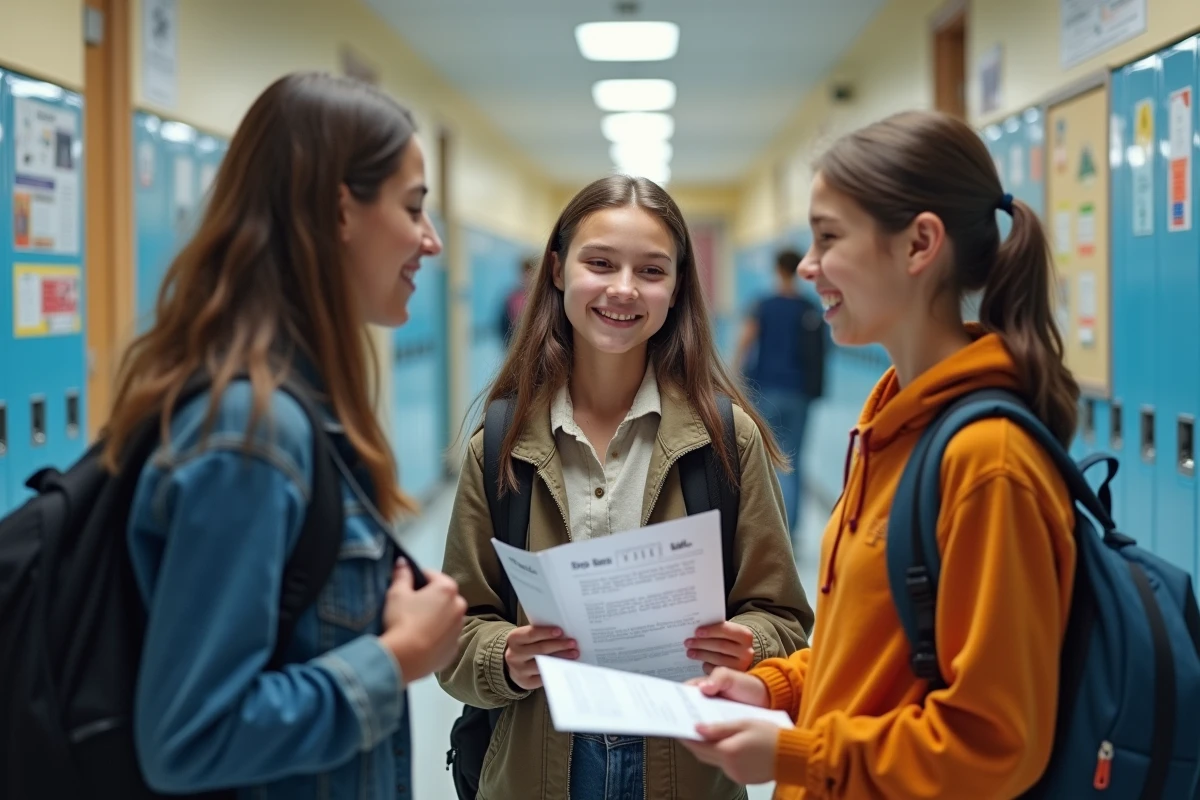
Concrete tips for progressing and succeeding in second year, regardless of the average
In general second year, success is not just a race for the best grade. Improving one’s results requires adopting effective habits. Attendance and long-term organization make the difference. Preparing a revision schedule helps distribute efforts, avoid last-minute stress, and better assimilate lessons.
Here are some concrete levers for daily progress:
- Prepare revision sheets to summarize the essentials of each chapter in maths, French, languages, or history-geography.
- Use flashcards for more dynamic and interactive revisions.
- The Scribzee app facilitates the digitization of study materials and their consultation at any time.
- Nomad Education provides quizzes, past papers, and flashcards adapted to the second year curriculum.
- Educational videos on YouTube allow for a deeper understanding of more complex chapters.
- Joining a study group encourages exchange, reformulation, and accelerates the understanding of difficult concepts.
Paying attention to one’s well-being is equally crucial. A good sleep rhythm, a balanced diet, moments to relax and move: all these elements support concentration, motivation, and progress. A rested student makes better use of their teachers’ advice and the support offered.
General second year resembles a springboard: the average is just a reference point, the learning dynamic makes the difference. Moving forward, adjusting, exploring, that is what shapes a solid path for the future.