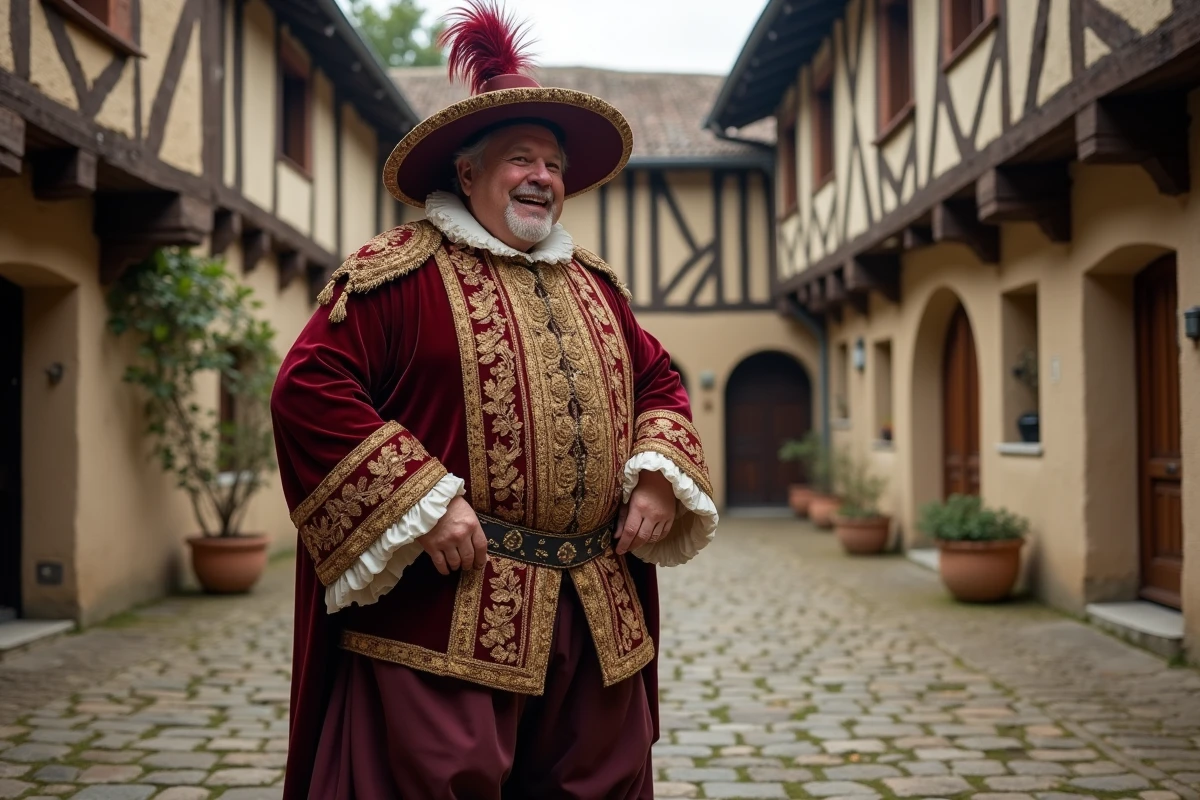
In Rabelais’ novel, each character bears a name that serves as a clue. Grandgousier, Gargamelle, Picrochole: these label-names announce a character trait, a flaw, or a role in the narrative. Recognizing the characters of Gargantua means first understanding this system of speaking names, and then spotting how each embodies a specific idea about education, power, or war.
Speaking names in Gargantua: the key to identifying each figure
Rabelais does not choose his names at random. Each name functions as a condensed portrait. Grandgousier literally means “big throat,” which refers to his appetite, but also to his overflowing generosity. Gargamelle, the mother of Gargantua, also evokes the throat and excessive eating.
The name of Gargantua himself comes from an exclamation by his father at his birth: “How big you are!” referring to his throat. This improvised baptism summarizes the entire logic of the novel. The character’s name announces his deep nature.
This process extends to secondary figures. Ponocrates, the good tutor, derives his name from the Greek “ponos” (work, effort). Thubal Holoferne and Jobelin Bridé, the bad masters, have names that evoke heaviness and constraint. Picrochole, the belligerent enemy, combines “pikros” (bitter) and “kholê” (bile): he is the irascible one by definition. By finding the description of the characters of Gargantua, one realizes how much this logic of names permeates the entire narrative.
Have you noticed the principle? Each character is a humanist concept or its opposite, embodied in a body and adorned with a transparent name.
Two opposing camps: Rabelais’ value system
The novel does not distribute its characters randomly. They are divided into two camps that clash on everything: the way to govern, educate, wage war, and live together.
The camp of Grandgousier: the humanist ideal
On the positive side, we find Gargantua’s family and their allies. Grandgousier is a peaceful sovereign. When Picrochole invades his lands, he first attempts diplomacy. He sends messengers, proposes compensations, seeks peace above all else. This hedonistic king represents power exercised with moderation.
Gargantua extends this ideal. After a failed education that is then reformed, he becomes a learned prince, capable of fighting but also of thinking. His educational journey is the guiding thread of the novel.
Ponocrates, his humanist tutor, embodies the pedagogical method that Rabelais advocates. Where the old masters made students recite texts, Ponocrates offers a comprehensive program:
- Direct observation of nature and trades, not just reading ancient books
- Daily physical exercise (equestrianism, swimming, weapon handling) integrated into intellectual training
- Critical discussion of the texts read, to develop judgment rather than just memory
Brother Jean des Entommeures completes this group. This fighting monk, who defends his vineyard with a cross staff, represents the man of action. Brother Jean acts when others pray or flee. Rabelais makes him a comical yet admirable character, in contrast to the contemplative monks he criticizes.
The camp of Picrochole: the satire of bad power
On the other side, Picrochole embodies everything Rabelais condemns. This neighboring lord starts a war over a story of stolen fouaces (flatbreads). The pretext is ridiculous, the reaction disproportionate.
Picrochole consults no one, refuses negotiation, dreams of conquering the entire world. His flattering advisors promise him North Africa, Spain, Italy. The scene of imaginary conquests parodies the ambitions of bellicose kings.
Surrounding him are boastful captains and servile advisors. Only one, Échéphron (whose name means “the prudent”), dares to suggest moderation. No one listens to him. This isolated figure reminds us that bad power does not tolerate contradiction.
Education in Gargantua: recognizing the good and bad masters
The theme of education structures the entire first part of the novel. Rabelais contrasts two pedagogical methods through very recognizable characters.
Thubal Holoferne is Gargantua’s first tutor. He makes him learn the alphabet for several years, then recite Latin grammars by heart. The result: Gargantua becomes more foolish than before. Jobelin Bridé, who succeeds him, applies the same method with the same disastrous results.
These two masters embody the scholastic education that Rabelais rejects. Their approach relies on mechanical repetition, without reflection or openness to the world. The portrait is deliberately caricatural: Rabelais exaggerates the traits so that the reader immediately understands what does not work.
The arrival of Ponocrates brings about a radical change. The new tutor begins by purging Gargantua of his bad habits with hellebore (a plant used as a remedy in antiquity). Then he reconstructs his schedule around a simple principle: learning by doing.
The difference between the two approaches is evident in their bodies. Under Thubal Holoferne, Gargantua is apathetic. Under Ponocrates, he runs, swims, climbs, observes the stars, visits workshops. The good tutor shapes the body as much as the mind.
Brother Jean and the Abbey of Thélème: an ideal at the end of the novel
After the victory over Picrochole, Gargantua rewards Brother Jean by allowing him to found the Abbey of Thélème. This place operates in contrast to traditional monasteries: no walls, no clocks, no imposed rules. The only motto is “Do what you will.”
The inhabitants of Thélème are selected: beautiful, well-educated, free. The abbey welcomes men and women together, which is unthinkable for the time. Rabelais imagines here a community based on trust in human nature.
Brother Jean, paradoxically, does not fit the profile of the thélémites. He is a raw, gluttonous, brawling man. This discrepancy between the founder and his abbey is part of the humor of the novel.
- Thélème rejects the monastic constraints (schedules, silence, enclosure) that Brother Jean himself has endured
- The thélémites embody the culmination of the humanist education advocated by Ponocrates
- The motto “Do what you will” assumes that well-educated people will naturally choose the good
This last point summarizes Rabelais’ philosophy throughout the novel. The characters of Gargantua are not mere comic figures. Each carries an argument about what a good king, a good master, a good monk should be. Recognizing them means reading Rabelais’ humanist program through his most extravagant creations.