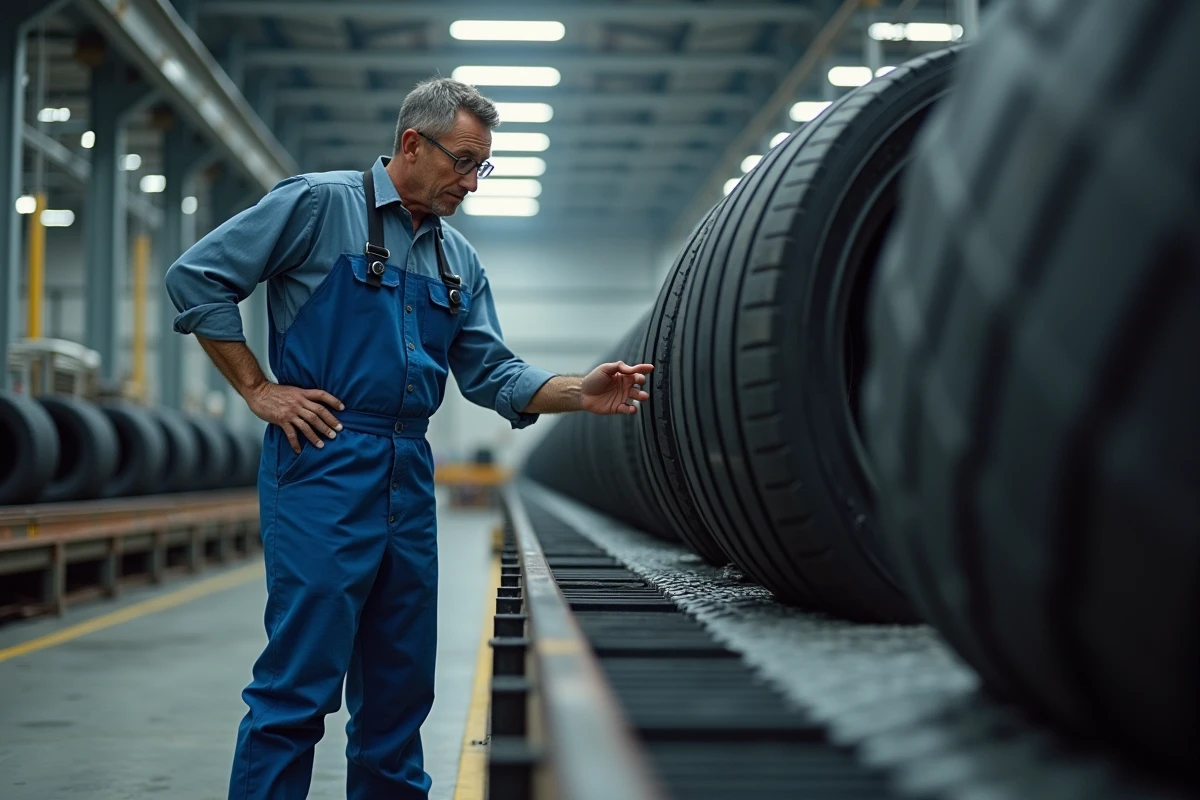
Rognonas, Bouches-du-Rhône: it is here, in the deceptive calm of southern France, that hundreds of Kleber tires leave the production lines every day to roll towards the fields of Europe. Founded in 1910 in Colombes, the brand has weathered the decades, absorbed by Michelin without fading away, and continues to assert its identity. Behind each tire: an alchemy that is anything but ordinary, combining state-of-the-art robots and skilled gestures inherited from passionate workers. Kleber relies on a solid European network, but its roots remain deeply embedded in French soil, especially for the volumes that come out of its industrial sites.
A French Heritage: The History and Roots of Kleber
Behind the name Kleber lies much more than just an industrial saga. As early as 1910, in a bustling Parisian suburb, the Société Française B. F. Goodrich was born. Inspired by innovations from the United States, it quickly established itself as a spearhead of tire manufacturing in France. In 1945, the brand changed direction and proudly displayed: Kleber-Colombes, in homage to the avenue that houses its headquarters, sealing the link between the company and the modernity of a France healing its post-war wounds.
The stylized boxer that now adorns the sides of the tires is not there by chance. It embodies the brand’s commitment: robustness, loyalty, and long-lasting presence. As cars flood the roads and tractors transform the countryside, Kleber establishes itself as a landmark, relying on the transmission of skill and demand within each Kleber tire manufacturing plant.
In the workshops, innovation does not chase away tradition. Generations succeed one another, techniques evolve, but the attention to quality does not wane. Whether at the historic site in Colombes or at other French locations, each Kleber tire still bears the mark of this story woven with rigor and boldness. The company continues to uphold its promise: to support French mobility, without compromising on quality.
Where are Kleber Tires Made? An Overview of Their Factories
To understand where Kleber tires are born, one must look beyond the hexagonal borders. The industrial network extends from France to Eastern Europe, with each site strengthening the brand’s ability to meet demand.
In Troyes, in the Grand Est region, one of the most emblematic sites focuses on manufacturing tires for passenger cars and utility vehicles. Here, it is tradition combined with flexibility: generations of workers have shaped a know-how that adapts to market expectations. The Troyes factory does not work alone. Other sites, such as those in Colombes, Clermont-Ferrand, or Cholet, each occupy a strategic place in the production chain.
In Romania, the Zalău factory takes over for the Dynaxer UHP and HP4 models, known for their performance, especially on wet roads. This diversity of sites allows Kleber to offer a complete range, from summer tires to all-season tires, including winter references. The manufacturing steps, from the selection of raw materials to the final inspection, follow a rigor that ensures traceability and consistency of the product.
Thanks to this network, Kleber remains close to its markets, able to quickly adjust its volumes and provide tires that precisely meet local uses. This hybrid organization, both rooted and open, constitutes the brand’s signature.

Manufacturing Secrets: Quality, Innovation, and Expertise at the Heart of Kleber Workshops
Pushing open the door of a Kleber workshop reveals a precision mechanism, where every detail counts. The manufacturing process leaves nothing to chance: each step, from the mixing of rubbers to the final assembly, is designed to guarantee performance and safety.
Before reaching the production line, the raw materials undergo meticulous selection. Rubber, textile and metal reinforcements, additives… everything is carefully measured and assembled to form tires capable of enduring long distances. In the range, references such as the Dynaxer HP4 or UHP for summer, the Quadraxer 3 for all seasons, or the Krisalp HP3 for winter can be found.
Low rolling resistance remains a constant objective, aiming to limit fuel consumption and offer greater longevity. But the demand does not stop there. At every stage, quality controls are conducted: tests for resistance, grip, and endurance. This protocol, repeated tirelessly, forges the brand’s reputation for reliability.
Innovation, on the other hand, has never ceased. Kleber was one of the first to offer a tubeless tire in the early 1950s. This ability to innovate while preserving artisanal rigor has earned the brand international recognition and several professional awards.
In the end, each tire that leaves the Kleber workshops carries a bit of this tradition and a lot of this demand for excellence. On the road, in the fields, or in the heart of the city, Kleber tires carve their path, faithful to a history and a know-how that, evidently, have not yet said their last word.